What temperature kills Legionella?
Legionella grows at 20-45C, is held back at 50-60C, and dies faster as temperatures rise. See the kill temperatures and daily control targets.
Risk assessment, temperature, monitoring and the law, explained for the people who carry the duty.
An independent, free UK Legionella reference. Every figure is cited to HSE, ACoP L8 and the BS standards, and reviewed by an LCA-registered water-safety team.
Legionella multiplies fastest between 20 and 45°C. Drag the bar or type a reading.
Legionella only becomes your problem when warm water sits still and then gets breathed in, understand those two conditions and the whole subject gets simpler.
There is no single Legionella law; the duties come from general health and safety law and land on whoever controls the building, so the real question is who is accountable and what proves control.
A Legionella risk assessment is a decision document, not a certificate; its job is to rank what could grow, who is exposed, and what to fix first.
Look past single readings and judge whether the whole water system can hold control.
Flushing and monitoring are the two day-to-day halves of Legionella control; do them as a managed routine, not a tick-box, and you cover most of the everyday risk.
A logbook's only job is to turn the work you did into proof you can hand to an auditor, an inspector, or whoever inherits the building, and the proof lives in the exceptions, not the green ticks.
Free to read, no sign-up and no paywall. Written for UK duty holders and kept current as guidance changes.
Ten pillars covering the whole duty, from the science to enforcement.
Free, no sign-up. They answer the questions that come up first, and do the small sums that otherwise mean a spreadsheet and a guess.
The duties are the same; the buildings are not.
The guides people come back to once they are past the basics.
Legionella grows at 20-45C, is held back at 50-60C, and dies faster as temperatures rise. See the kill temperatures and daily control targets.
No single flush-and-test schedule fits every building. Here's how to set Legionella flushing, temperature and sampling frequencies from the risk assessment.
A TMV blends water down to a safe temperature, and into the range Legionella loves. Where to put your checks, what to service, and why valve location matters.
What Legionnaires' disease feels like in the first days, how it differs from flu or COVID, who is most at risk, and exactly when to ring 111 or your GP.
How to flush little-used taps and showers properly: which outlets to list, how to purge them without spraying aerosol, and how to prove it was done.
Continuous water temperature data only helps if it changes a decision. How UK teams place sensors, set alerts and prove control without ditching the probe.
Why this matters
Legionnaires’ disease is a serious, sometimes fatal pneumonia, and hundreds of people are diagnosed in England and Wales every year. UK law treats failing to control the risk as a criminal matter, with no upper limit on the fine.
Sources: UKHSA, legionellosis in residents of England and Wales (2024) and the 2017 to 2023 report (deaths); Health and Safety at Work etc. Act 1974, Schedule 3A. Penalties are the maximum on conviction on indictment; imprisonment applies to individuals responsible.
Enforcement is real
These are real prosecutions for failing to control Legionella. Fines now reach six and seven figures, and individual managers, not just the organisation, can be held to account.
The £3m fine was reduced to £1.5m on appeal in October 2019.
2018 · a death occurred
Bupa Care Homes (BNH) Ltd
Care home
For more than a year during refurbishment works, Bupa failed to implement the controls and monitoring needed to safely manage a care home’s hot and cold water system, and failed to properly train the staff responsible. The resident is thought to have been infected from a hot tap in his room.
Legionella Control News (2018) ›2024
Sanctuary Housing
Social housing (sheltered)
The landlord poorly managed the Legionella risk in the water system at Vincent Naughton Court, Birkenhead, with staff inadequately trained and supervised. A warning letter told residents the water could be boiled but failed to tell them to stop using their showers.
Inside Housing / HSE (Oct 2024) ›2024 · a death occurred
Amey Community Ltd
Facilities management (prison)
The facilities-management contractor failed to act on a 2016 Legionella risk assessment, had no written scheme of control in place, and did not monitor or maintain safe water temperatures in the prison’s water system.
HSE prosecution report (Dec 2024) ›A selected set of landmark cases; HSE does not publish Legionella prosecutions as a single dataset.
All prosecutions and how courts sentenceFrom the team behind Legionella.io
Legionella.io is published by REMOTE TECH LTD (RT), the UK water-safety technology company behind L8log. L8log brings risk assessment, digital logbooks, remedial tracking and remote temperature monitoring into one compliance ecosystem for duty holders and water-hygiene teams.


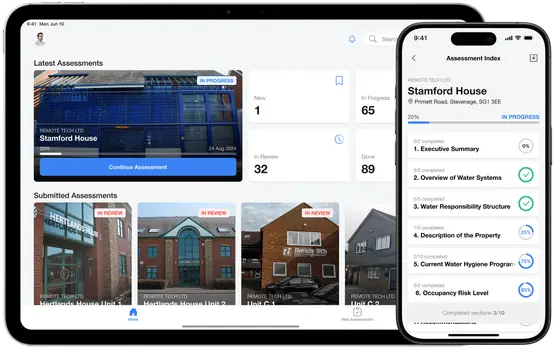
Build and update site risk assessments, then track every remedial action through to close-out.
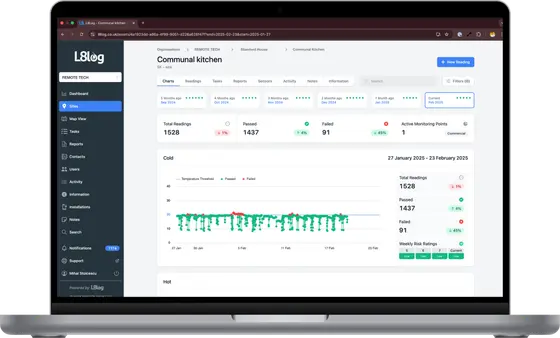
Wireless temperature sensors and live dashboards that flag drift before it becomes a failure.
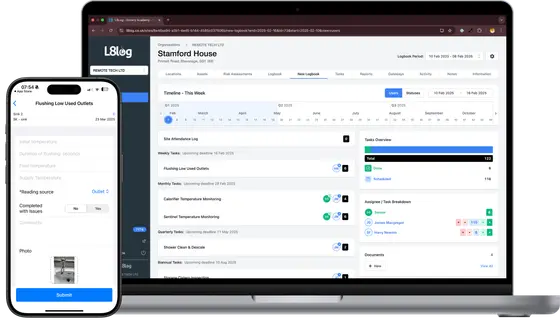
Every temperature, flush and sample logged, time-stamped and ready for an inspector.
Things to use and download, not just read.
About this resource
Legionella.io is a free, independent UK Legionella reference. Every figure is cited to a primary source, so you can check it yourself, and the guidance is reviewed by an LCA-registered water-safety team. It is published by Remote Tech Ltd, who also make L8log, our compliance software: we earn when readers choose L8log, but the guidance never changes to suit it, and where you do not need software we say so.